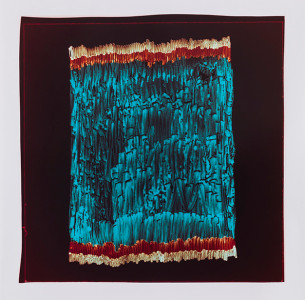
Ok, so the title may be a bit misleading. In seeing this new set of galleries, one of the exhibitions that really caught my eye was John Houck, not necessarily photography, but interesting. The patterns printed on his works spoke to the digital processes. The designs were subtle and often misleading as the creases of the pages they were printed on became a part of the design, and the design became a part of the crease, and so on. This play between manual processes and digital processes to create a clean and beautiful aesthetic design despite the lack of cleanliness in folding paper intrigues me.


But how does this type of work translate to photography? One of my other interests lies in trying to destroy a photograph in whatever way that I can to create a distorted reality. Typically my work is illustration, in which I try to design a fantasy; or space and things that don't exist. But photography is so honest, that it is hard to try to capture things that aren't truth. However, through digital editing, and manual altercations, it can be achieved. And while digital editing is an option I wouldn't mind, ti is the attempt at creating a manual scene that intrigues me.
I plan to use this project to take a portrait and filter it, but not digitally, manually. Using acetate and crumpled tissue, as well as paint and patterns to replicate something close to what we see in John Houck's work, only, with a subject lying behind it.
------------------------------------------------------------------------------------------------------------------
After taking some time out to choose the different ways in which I could capture the image as described above, the most important conclusion I came to is that the lighting in my apartment is irreparable shit. However, I still think that I got some solid images out of it.
One of the things that I noticed is that it is hard to notice the folds and creases that cover the subject in the images, this interested me because although they were just as much a part of the image, the camera fought not to focus on them and, instead, the subject. In most scenarios, this would be a positive thing, but lo and behold, as soon as you need it to behave differently, it will fight back. My images were a result of the following experiments, in order.
Standard - Crumpled Acetate - Acetate with Water - Acetate with Watercolour
I still would be interested in further experiments such as folding the photo and scanning it in again with the creases, which would probably better mimic John Houck, among other things, however, for a start, I was pretty happy with the results, particularly because my interest lies more in seeing subjects through glass, and now that I know how I can add intrigue and destruction to the images, I have ideas for how to pursue my own interests.




.jpg)


